

Advertisement
{{ galleryProps.activeIndex + 1 }}/1
Description
The Lotus Esprit is a sports car manufactured by Lotus Cars from 1976 to 2004 at its factory in Hethel, England.
The Esprit was among the first of the (nearly) straight-lined, hard-edged, creased, and sometimes wedge-shaped, polygonal "folded paper" designs by the prolific and highly successful Italian industrial and automotive designer Giorgetto Giugiaro. The Esprit's backbone chassis was later adapted to support the body of the DeLorean, another low-slung, Giugiaro-designed, sharply creased, wedge-shaped sports car.
The Esprit was unveiled in October 1975 at the Paris Motor Show and went into production in June 1976, replacing the Europa in the Lotus model lineup. These first cars became known as "Series 1" (or S1) Esprits.
In 1978, the revised Series 2 (or S2) Esprit was introduced. The S2.2 was a stopgap model introduced in May 1980; its only major difference from the S2 was, as indicated by its model name, that it had a 2.2-liter engine.
----- ----- ---- ----
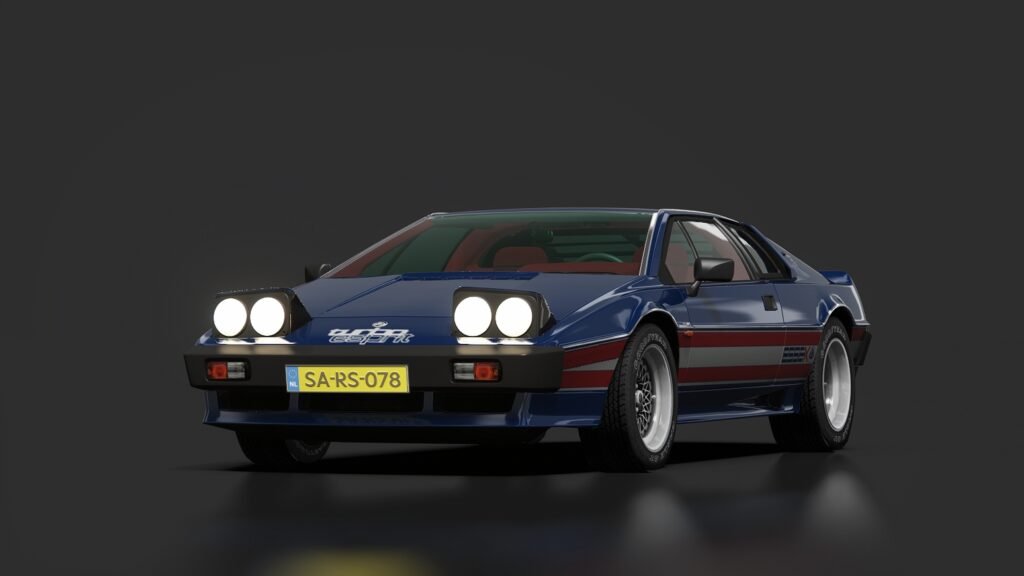
Essex Turbo Esprit (1980) ---- THIS VERSION
In 1980, the Essex Turbo Esprit was launched. This special edition model featured the blue, red, and chrome livery of the Essex Overseas Petroleum Corporation, the sponsor of Team Lotus from 1979 to 1981. While the Lotus dealer…
The Lotus Esprit is a sports car manufactured by Lotus Cars from 1976 to 2004 at its factory in Hethel, England.
The Esprit was among the first of the (nearly) straight-lined, hard-edged, creased, and sometimes wedge-shaped, polygonal “folded paper” designs by the prolific and highly successful Italian industrial and automotive designer Giorgetto Giugiaro. The Esprit’s backbone chassis was later adapted to carry the body of the DeLorean, another low-slung, Giugiaro-designed, sharply creased, wedge-shaped sports car.
The Esprit was unveiled in October 1975 at the Paris Motor Show and went into production in June 1976, replacing the Europa in the Lotus model lineup. These first cars became known as “Series 1” (or S1) Esprits.
In 1978, the revised Series 2 (or S2) Esprit was introduced. The S2.2 was a stopgap model introduced in May 1980; its only major difference from the S2 was, as indicated by its model name, that it had a 2.2-liter engine.
—– —– —- —-
Essex Turbo Esprit (1980) —- THIS VERSION
In 1980, the Essex Turbo Esprit was launched. This special edition model featured the blue, red, and chrome livery of the Essex Overseas Petroleum Corporation, the sponsor of Team Lotus from 1979 to 1981. Although Lotus dealer Bell and Colvill had been offering turbo conversions for the S2 Esprit as early as 1978, the Essex Turbo Esprit was the first factory-turbocharged Esprit.
The chassis and rear suspension were redesigned, with an upper link added at the rear to reduce stress on the half-shafts. The brakes were also improved. Giugiaro designed an aerodynamic body kit for the car, featuring a rear lip spoiler, a prominent louvered rear hatch, more substantial bumpers, a deeper front airdam, and air ducts in the sills just ahead of the new three-piece 15-inch Compomotive rear wheels. Inside, scarlet leather combined with a roof-mounted Panasonic stereo to create a dramatic atmosphere. Forty-five Essex Turbo Esprit cars were built, interspersed with and followed by a number of dry-sump turbo cars that did not feature the Essex livery but were otherwise identical in specification.
Thanks to forced induction and improvements in power output, even with just four cylinders, the Esprit became a serious competitor to Porsche and Ferrari—from its increased top speed to its improved handling and reliability.
Very easy to drive and push to the limit, the Esprit set the standard for all Lotus cars that followed and remained a success for nearly 30 years.
Two Essex-spec Turbo Esprits—one white and the other copper—appeared in the James Bond film *For Your Eyes Only* (1981),
—– —– —– —–
The Series 3 (or S3) and Turbo Esprit debuted in April 1981. The two models shared a common chassis, and their bodywork was based on a common set of molds.
The final versions of the Giugiaro-styled Esprit were announced in April 1986. Higher compression ratios for the engines were indicated by the ‘HC’ designation. Power output of the naturally aspirated engine rose to 172 PS (127 kW; 170 hp) and 160 lb⋅ft (217 N⋅m) for the Esprit HC, and to 218 PS (160 kW; 215 hp) and 298 N⋅m (220 lb⋅ft) for the Turbo Esprit HC, with more torque available at lower engine speeds.
Another redesign of the car in 1993, designed by Julian Thomson, resulted in the Series 4 (or S4). The S4 was joined in 1994 by the S4 Sport (S4s). Engine output increased to 305 PS (224 kW; 301 hp) and 393 N⋅m (290 lb⋅ft) of torque.
In 1996, Lotus launched the Esprit V8. The car was equipped with Lotus’s own Type 918 V8 engine. The engine is an all-aluminum 90° DOHC design with four valves per cylinder, a flat-plane crankshaft, and two Garrett T25/60 turbochargers, but no charge cooler.
In 1998, the V8 lineup was divided into SE and GT models. The ultimate incarnation of the Esprit was the 1999 Sport 350. Only 50 were made. The ECU in the Sport 350 was remapped to deliver the same 350 horsepower as the Lotus Type 918 (as indicated by the name).
—– —– —– —– —–
1980 Lotus Essex Turbo Esprit (5-speed manual) (European model) car specifications
Make: Lotus
Model: Esprit 1975–2004
Submodel: Esprit Giugiaro Series 1976–1987
EEC segmentation: S (sports cars)
Subsegment: S-C (sport coupes) – executive
Class: grand tourer
Body style: hatchback coupe
Doors: 2
Engine manufacturer: Lotus 910
Engine type: spark-ignition 4-stroke
Fuel type: gasoline (petrol)
Fuel system: 2 carburetors
Charging system: turbocharger
Valves per cylinder: 4
Additional features: Dell Orto 40 DHLAH, Garrett T3 turbo 8.0 psi (0.5 bar) / DOHC belt-driven
Cylinder alignment: Line 4 2.2L
Displacement: 2174 cm³ / 132.5 cui
Net horsepower: 156.5 kW / 213 PS / 210 hp (DIN) / 6000–6500
Net torque: 271 Nm / 200 ft-lb / 4000–4500
Idle: 950–1000 rpm
Ignition cut-out: 7,300 rpm
Curb weight (without a driver): 1148 kg / 2531 lbs
Front/rear weight distribution (%): 42.5 / 57.5
Fuel Tank: 86 Lt (18.9 galls)
Traction: RWD (rear-wheel drive)
Open differential (not LSD)
Transmission type: manual
Number of gears: 5
Gear ratios (overall):
I 2,923 (12.79)
II 1,941 (8.49)
III 1,321 (5.78)
IV 0.97 (4.24)
V 0.757 (3.31)
R 3,154
Final drive ratio std: 4.375
Standard tires: 195/60 VR 15 (F); 235/60 VR 15
Lateral acceleration: 0.81 g (8 m/s²)
Steering: 3.1 turns from lock to lock
Suspension
Front: Upper Wishbone w/Lower Transverse Link, Coil Springs, Anti-Roll Bar
Rear: Double Transverse Links w/Radius Arms, Coil Springs
Brakes:
Front: 267 mm / 10.5-inch discs
Rear: 246 mm / 9.7-inches discs
Braking 100-0 kmh: 46,31m Estimated —— 44,6 m tsa
Performance – Factory claim
Top speed: 245 km/h / 152 mph —— 244 tsa
0-60 mph (s): 5.55
0-100 km/h (s): 5.8 ——- 5.95 tsa
Drag
0-1/4 mile (s): 14.4 ——- 14.27 tsa
0-1 km (s): 26.1 ——– 26.00 tsa
Estimated
Top speed: (theor. without speed governor) 243 km/h / 151 mph
Acceleration:
0-100 km/h (s): 6
0-160 km/h (s): 14.3
0-60 mph (s): 5.5
0-100 mph (s): 14.5
Drag times:
0- 1/4mile (s): 14.1
speed at 1/4mile: 158 km/h / 98 mph
0- 1km (s): 25.8
Official track times:
Willow Springs 1:43.30 (fastestlaps.com 1981 turbo +-100kg plus?) ——- 1:40.614 Essex AC Tested
Download Link
Any problems? Send a message below
Advertisement
Recommended posts


Nissan GT-R R35 Liberty Walk Silhouette - Baggsy
Assetto Corsa
2017
957 hp
1,176 nm
Rear - RWD
Drift

 Português do Brasil
 English
 Türkçe
 Español de Argentina
 Русский