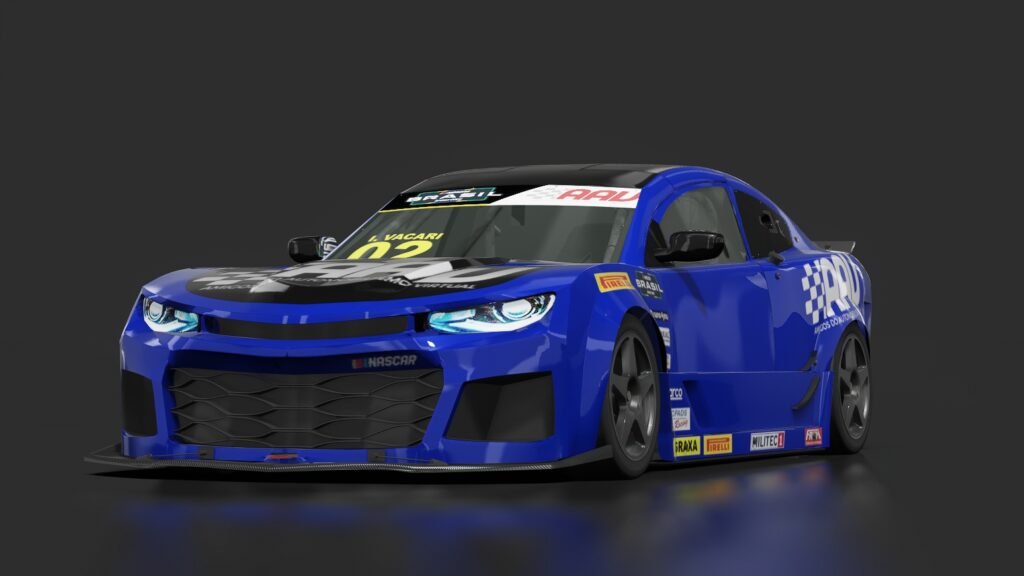
The iconic Camaro arrives at NASCAR Brazil with a mid-engine layout and raw performance. The ultimate machine for those aiming for the top of the podium on Brazilian circuits.
The cars in the NASCAR Brasil Sprint Race featured a tubular space-frame chassis reinforced with aluminum plates. In its original form, the car used an unbranded hatchback body based on the Renault Clio. The driver is positioned in the middle of the car for better weight distribution. It uses a six-speed sequential transmission, independent suspension, and engines supplied by Action Power. For the first two seasons, the cars used 220 hp inline-four turbo engines sourced from Renault before being upgraded to a 270 hp, 3.6-liter V6 engine sourced from Chevrolet in 2014.[5]
A new generation of cars was introduced by the series in 2020. The new car featured a brand-new body design inspired by the American NASCAR series, with composite body styles based on the Chevrolet Camaro and Ford Mustang available for participating teams to choose from; the NASCAR Brasil Sprint Race is one of two NASCAR series in which Toyota does not participate, the other being the NASCAR Canada Series. The new generation of cars featured an improved…
The iconic Camaro arrives at NASCAR Brazil with a mid-engine layout and raw performance. The ultimate machine for those aiming for the top of the podium on Brazilian circuits.
The cars in the NASCAR Brasil Sprint Race featured a tubular space-frame chassis reinforced with aluminum plates. In its original form, the car used an unbranded hatchback body based on the Renault Clio. The driver is positioned in the middle of the car for better weight distribution. It uses a six-speed sequential transmission, independent suspension, and engines supplied by Action Power. For the first two seasons, the cars were powered by 220 hp inline-four turbo engines sourced from Renault before being upgraded to a 270 hp, 3.6-liter V6 engine sourced from Chevrolet in 2014.[5]
A new generation of cars was introduced by the series in 2020. The new car featured a brand-new body design inspired by the American NASCAR series, with composite body styles based on the Chevrolet Camaro and Ford Mustang available for participating teams to choose from; the NASCAR Brasil Sprint Race is one of two NASCAR series in which Toyota does not participate, the other being the NASCAR Canada Series. The new generation of cars featured an improved aerodynamic package and was claimed to have a 20% increase in corner speed, despite the removal of the detached rear wing in favor of an integrated rear spoiler.[11]
The new-generation car underwent several changes for the 2022 season. New racing seats, inspired by those used in NASCAR, were introduced to better protect drivers from head and neck injuries caused by lateral movement during crashes. A rear stabilizer bar was added, allowing drivers to choose between three settings: Soft, Hard, and Off. The engine also received an updated electronic fuel injection system to improve its acceleration.[10]
The NASCAR Brasil Sprint Race featured Pirelli as the series' exclusive tire supplier. Pirelli has been the exclusive tire supplier since the inaugural season in 2012, with the exception of the 2020 season, when the series used Yokohama tires instead.












 Português do Brasil
 English
 Türkçe
 Español de Argentina
 Русский