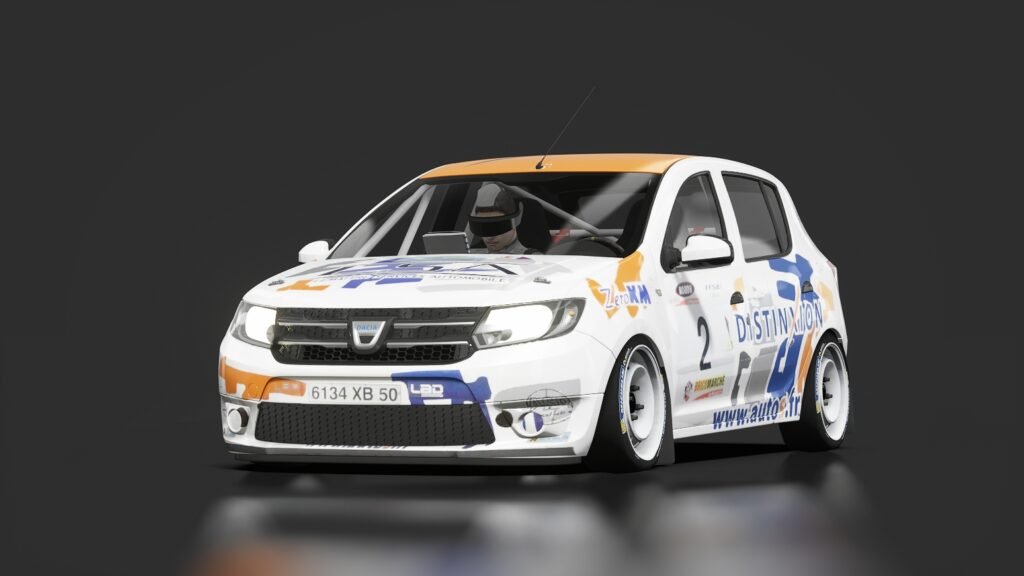
The Sandero is a hatchback car developed by Renault do Brasil and Romania's Dacia - a subsidiary of Renault, aimed especially at the developing Eastern European and Latin American markets. The car is based on the M0 platform (at its launch on the B0), the same used by the European Clio III and Renault Logan, and although it is a hatchback, it is positioned in a market (and price) segment above the Logan, the model from which it derives.
From different angles, you can see that the Sandero's design is clearly inspired by that of the European Clio III. Both cars also have very similar external dimensions. However, the Clio III is much more refined in terms of finish and has more comfort and safety equipment.
The Brazilian Sandero was restyled in 2011, with a front inspired by the European Clio III. The Stepway version was also restyled. The rear was slightly modified and gained Fluence-style lettering. The interior received better finishes and the model was given the option of a four-speed automatic gearbox. The model should inspire a future restyling of the European Sandero. A new generation Sandero has already been on sale since 2012 in Europe, and is sold in...
The Sandero is a hatchback car developed by Renault do Brasil and Romania's Dacia - a subsidiary of Renault, aimed especially at the developing Eastern European and Latin American markets. The car is based on the M0 platform (at its launch on the B0), the same used by the European Clio III and Renault Logan, and although it is a hatchback, it is positioned in a market (and price) segment above the Logan, the model from which it derives.
From different angles, you can see that the Sandero's design is clearly inspired by that of the European Clio III. Both cars also have very similar external dimensions. However, the Clio III is much more refined in terms of finish and has more comfort and safety equipment.
The Brazilian Sandero was restyled in 2011, with a front inspired by the European Clio III. The Stepway version was also restyled. The rear was slightly modified and gained Fluence-style lettering. The interior received better finishes and the model was given the option of a four-speed automatic gearbox. The model should inspire a future restyling of the European Sandero. A new generation Sandero has been on sale since 2012 in Europe, and has been sold in Brazil under the Renault brand since July 2014.
In 2020, Dacia (a Renault subsidiary) launched the 3rd generation Sandero and Stepway. Even with the adoption of the new platform, the new Sandero and Stepway are still 4.08 meters long, while they are 1.85 meters wide. The height has been reduced by 1 centimeter, to 1.50 meters. The roof has also been lowered by a few millimeters to improve aerodynamics and thus reduce CO2 emissions by a few grams.
With more technology and a more robust body, the overall weight has increased. Dacia reports that the new Sandero weighs around 40 kg more than the previous generation, making it weigh between 1,150 kg and 1,300 kg, depending on the version, engine and options chosen.
The end result of the styling is enough to make the Sandero look more dynamic, especially with the new front end design that uses a “Y” signature for the LED daytime running lights, which reminds us a lot of the older generation Audi A6. The smaller lanterns help make the rear end look bigger, although they also remind us of other models
The Stepway, on the other hand, will continue to be offered and has followed much of what was applied to the Sandero, since it is based on the hatchback. The hood is specific to it, with extra creases, the wheel housings are larger with a plastic cover and the ground clearance is 17.4 centimeters (against the Sandero's 13.3 cm). The grille is also specific, with a different interior finish.
For the first time in Europe, the new Stepway also has a modular roof rack. A key stored in the glove compartment allows you to unlock the bars and change their position between horizontal and vertical. They have a load capacity of 80 kg. They are expected to arrive in 2022.





 Português do Brasil
 English
 Türkçe
 Español de Argentina
 Русский