Based on: Panda & Shira 3D, Physics, Skins: Mad Agus Sound: Sergio Loro Help: Junkie
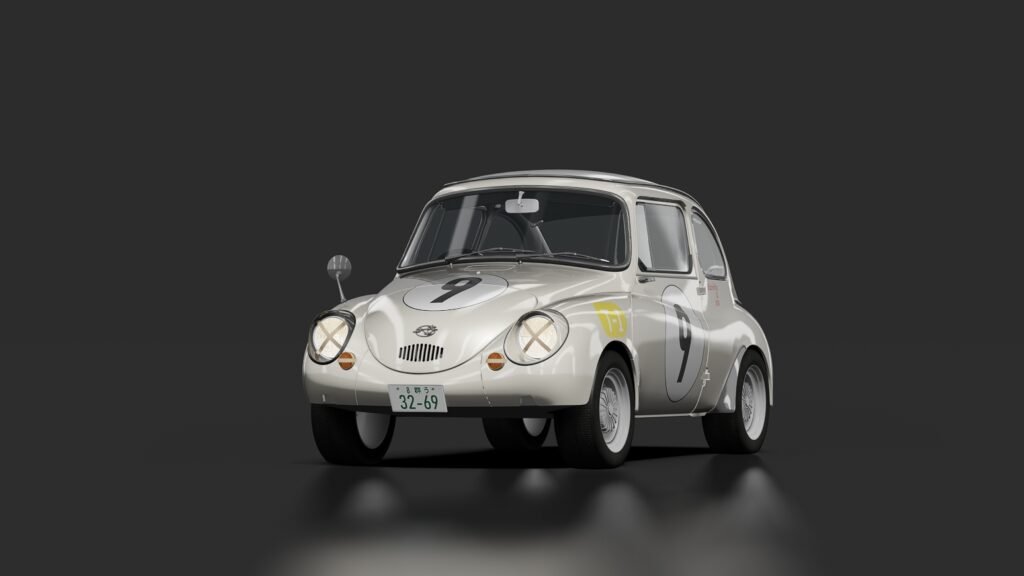
The Subaru 360, nicknamed the "ladybug," has remained virtually unchanged since the day it went on sale and has been beloved by many over the years. In 1955, Japan’s Ministry of International Trade and Industry urged automakers to produce a "people’s car," and Fuji Heavy Industries, drawing on some of its experience as Nakajima Airplane (as the company was known during World War II), developed the Subaru 360. Despite its appearance, four adults can sit comfortably inside, and the car is extremely fuel-efficient and fun to drive. Originally released in 1958, it appeared in numerous variants, such as the Young SS version, a cargo version, etc., and with different engine options (356 cc EK31, 356 cc EK32, 423 cc EK51). The first car race, the Japanese Grand Prix, was held in 1963, and the Subaru 360 competed in the C-I class (touring cars with engines of 400cc or less). Saburo, driving car number 5, finished third, while Akio, driving car number 7, finished…
Based on: Panda & Shira
3D, Physics, Skins: Mad Agus
Sound: Sergio Loro
Help: Junkie
The Subaru 360, nicknamed the “ladybug,” has remained virtually unchanged since the day it went on sale and has been beloved by many over the years. In 1955, Japan’s Ministry of International Trade and Industry urged automakers to produce a “people’s car,” and Fuji Heavy Industries, drawing on some of its experience as Nakajima Airplane (as the company was known during World War II), developed the Subaru 360. Despite its appearance, four adults can sit comfortably inside, and the car is extremely economical and fun to drive. Originally released in 1958, it appeared in numerous variants, such as the Young SS version, a cargo version, etc., and with different engine options (356 cc EK31, 356 cc EK32, 423 cc EK51).
The first car race, the Japanese Grand Prix, was held in 1963, and the Subaru 360 competed in the C-I class (touring cars with engines of 400cc or less). Saburo, driving car number 5, finished third; Akio, driving car number 7, finished fifth; and Teruo, driving car number 6, finished sixth.
In the 1966 Suzuka 500km race, two 360s competed in the T-1 class (for cars with 1,400 cc or less), driven by Noriyuki Koseki and Nakahara Kieito, but both retired after just a few laps.
O Brasil Simulator Mods It's free and supported by ads. If you can, Unlock our website in your AdBlock — it really helps keep the mods up and running. 🧡





 Português do Brasil
 English
 Türkçe
 Español de Argentina
 Русский