"The front-engine, rear-wheel-drive convertible that sparked a trend for two-seater Kei cars in Japan."
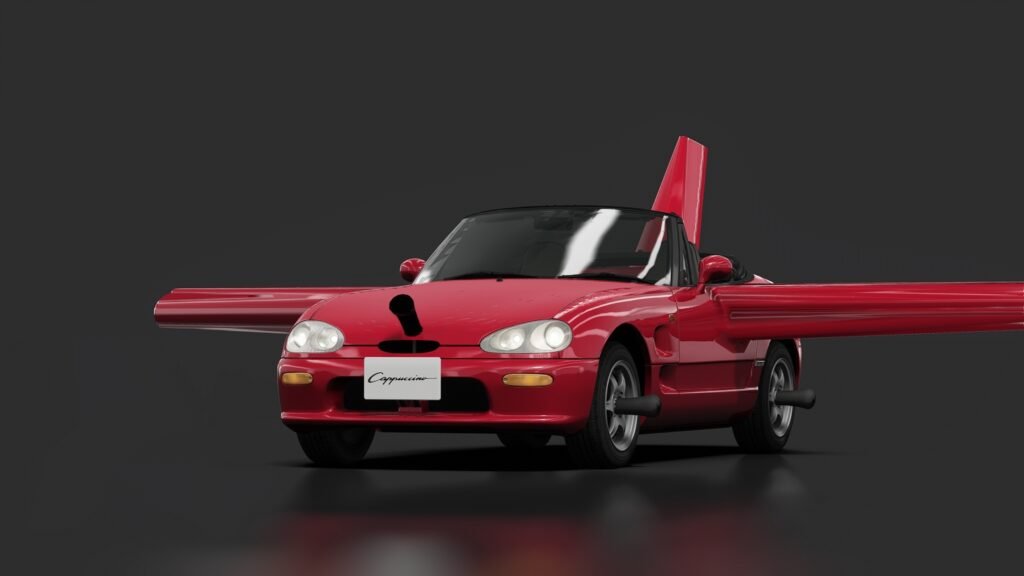
The Cappuccino, the kei car released by Suzuki in November 1991, was a car that proved these efficient mini cars could be stylish and sporty, joining the ranks of the now-legendary Honda Beat and Mazda Autozam AZ-1.
The Cappuccino's front-engine/rear-wheel-drive layout helped set it apart from the mid-engine configuration of the previously mentioned Beat and AZ-1. But what really set this Suzuki apart from the others was the fact that while most of them shared major components with other kei cars to help keep costs down, the Cappuccino featured an all-original body designed exclusively for this model.
Its stylized body was characterized by a rounded shape with a long front end, complemented by an innovative panelized roof that could be easily removed in three sections. Starting as a hardtop, it could be converted into a T-bar roof, a targa top, or—with the rear window lowered—a fully open-top car. The Cappuccino was powered by a turbocharged 657 cc DOHC 12-valve inline-3 engine that produced 63 BHP. Starting with the 1995 model, the engine was made entirely of aluminum, and the car’s weight distribution was improved to a nearly perfect…
“The front-engine, rear-wheel-drive convertible that sparked a trend for two-seater Kei cars in Japan.”
The Cappuccino, the kei car released by Suzuki in November 1991, was a car that proved these efficient mini cars could be stylish and sporty, joining the ranks of the now-legendary Honda Beat and Mazda Autozam AZ-1.
The Cappuccino’s front-engine/rear-wheel-drive layout helped set it apart from the mid-engine configuration of the previously mentioned Beat and AZ-1. But what really set this Suzuki apart from the others was the fact that while most of them shared major components with other kei cars to help keep costs down, the Cappuccino featured an all-original body designed exclusively for this model.
Its stylized body was characterized by a rounded shape with a long front end, complemented by an innovative panelized roof that could be easily removed in three sections. Starting as a hardtop, it could be converted into a T-bar roof, a targa top, or—with the rear window lowered—a fully open-top car. The Cappuccino was powered by a turbocharged 657 cc DOHC 12-valve inline-3 engine that produced 63 BHP. Starting with the 1995 model, the engine was replaced with an all-aluminum unit, and the car’s weight distribution was improved to a nearly perfect 51-to-49 front-to-rear balance. Along with a redesigned suspension at all four corners and four-wheel disc brakes (ventilated discs in the front), the Suzuki Cappuccino was truly a dream sports car in the kei car segment, having sold 26,500 units before production ceased at the end of 1998.
O Brasil Simulator Mods It's free and supported by ads. If you can, Unlock our website in your AdBlock — it really helps keep the mods up and running. 🧡





 Português do Brasil
 English
 Türkçe
 Español de Argentina
 Русский